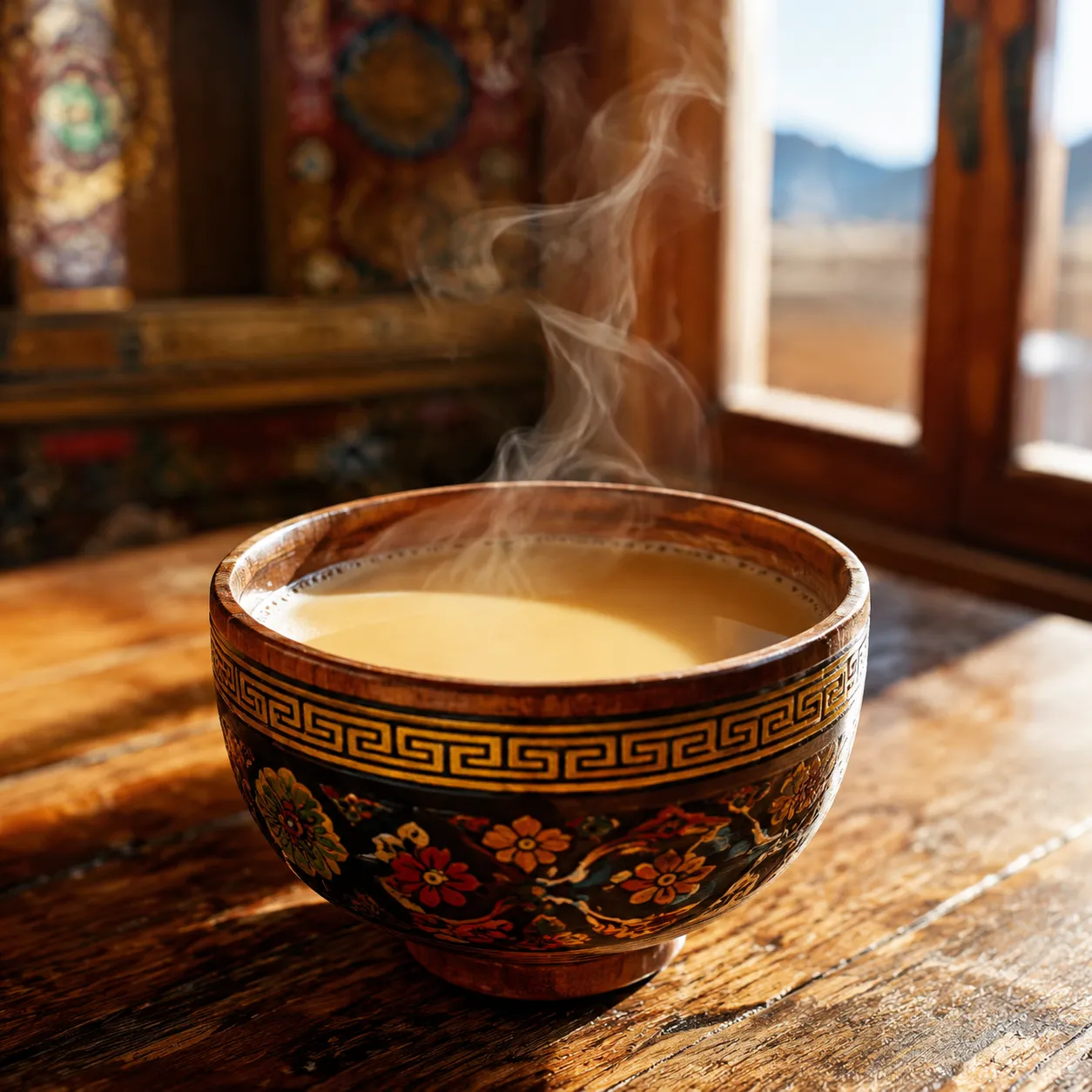
Yak Butter Tea (Su You Cha)
The lifeblood of Tibetan culture. Salty, rich, energizing, and endlessly replenished in every household, tea house, and monastery across Shangri-La. An acquired taste that rewards the adventurous.
What Is Yak Butter Tea?
Yak butter tea (u9165u6cb9u8336, su you cha) is the cornerstone of Tibetan cuisine and hospitality. The traditional recipe combines fermented dark tea leaves (often pu-erh), yak butter (rich, golden-yellow fat churned from yak milk), salt, and sometimes a splash of yak milk — all churned together in a wooden cylinder until emulsified into a smooth, creamy, slightly frothy liquid.
For the uninitiated, the first sip can be surprising. It is salty, not sweet. The flavor is earthy, unctuous, and deeply savory — closer to a soup or broth than what most people think of as "tea." The mouthfeel is rich and coating from the yak butter fat. It is, unmistakably, an energy drink: a single cup contains 200–300 calories, making it essential fuel for life at 3,000+ meters where the body burns extra energy staying warm.
In Tibetan culture, refusing yak butter tea is considered impolite. Hosts will continuously top up your bowl — if you've had enough, leave your bowl untouched and they will stop refilling. Draining it signals you want more.
Health Benefits
Tibetans credit yak butter tea with several practical health benefits at altitude: the high fat content provides sustained energy and warmth in cold climates, the salt replenishes electrolytes lost through increased respiration in thin air, the antioxidants in fermented tea support digestion of the heavy meat-and-dairy Tibetan diet, and the combination helps prevent chapped lips — a genuine concern in the dry highland air. Scientific studies have noted the tea's high levels of conjugated linoleic acid (CLA) from yak butter, which has anti-inflammatory properties.
Where to Try Yak Butter Tea in Shangri-La
Traditional Tibetan Tea Houses (Best Experience)
In Dukezong Old Town, look for small, family-run tea houses with low wooden tables and yak-hair cushions. The tea house near Sifang Street Square and those along Pijiang Po lane are excellent. 10–15 RMB per cup. These places are frequented by local Tibetans, offering the most authentic atmosphere. The tea is served in a thermos flask alongside small bowls.
Songzanlin Monastery Tea House
At the monastery exit, a simple tea house serves yak butter tea to pilgrims and visitors at 10 RMB. The experience of sipping tea while watching monks walk past in maroon robes is unforgettable.
Hotel & Guesthouse Breakfast
Most Tibetan-style guesthouses serve yak butter tea at breakfast, often included in the room rate. This is the easiest way to try it in a comfortable setting.
Where to Buy Yak Butter & Tea
Yak butter (u7266u6cb9): Sold at the morning market near the east gate of Dukezong Old Town for 30–50 RMB per 500g. Local farmers sell it wrapped in yak leather or cloth. It has a distinct golden color and rich aroma. In supermarkets in the new town, packaged yak butter is available for 40–60 RMB per 500g.
Fermented tea bricks: Sold at tea shops throughout the old town. Pu-erh tea bricks suitable for butter tea cost 20–60 RMB. A traditional wooden churn (dongmo) costs 100–200 RMB as a souvenir — the tea shops on Sifang Street stock them.
Pre-made butter tea powder (instant): Available in most supermarkets for 15–30 RMB per bag. Not as good as the real thing but convenient for travelers wanting to take the flavor home.
Related Food & Culture »