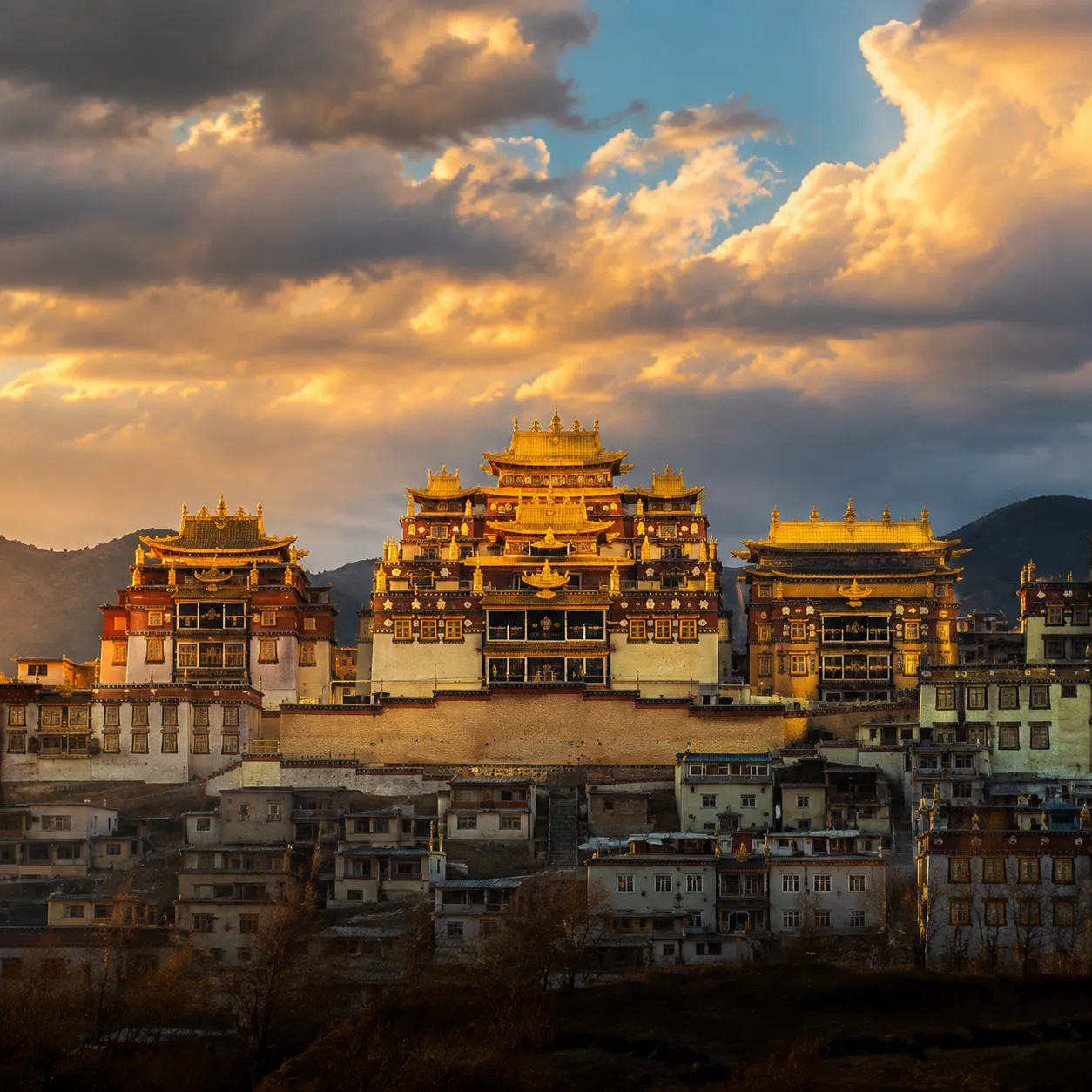
Songzanlin Monastery
The largest Tibetan Buddhist monastery in Yunnan. Built in 1679 and often called the Little Potala Palace. Morning chanting, golden roofs, and 700 monks in residence.
Overview
Songzanlin Monastery (噶丹松赞林寺), also known as Guihua Monastery, was built in 1679 under the patronage of the Fifth Dalai Lama. It is the largest Tibetan Buddhist monastery in Yunnan Province and belongs to the Gelugpa (Yellow Hat) sect of Tibetan Buddhism. The architectural style is modeled after the Potala Palace in Lhasa, earning it the nickname "Little Potala Palace".
The monastery complex sprawls across a hillside overlooking a sacred lake. At its peak, it housed over 2,000 monks. Today approximately 700 monks live and study here. The main assembly hall (Tsokchen) can hold 1,600 worshippers, with 108 red pillars supporting a golden roof visible from across the valley. Inside, Thangka paintings, butter lamp offerings, and towering gilded Buddha statues create an atmosphere of profound serenity.
The monastery is not a museum — it is a living religious institution. You will see young monks debating scriptures in the courtyard, elderly lamas circumambulating stupas with prayer beads, and locals prostrating before the main hall. The energy here is genuine and deeply moving.
Morning Chanting Experience
One of the most profound experiences at Songzanlin is the morning chanting ceremony (6:30 AM daily). Monks gather in the main assembly hall, seated in rows on long cushions, and begin deep, resonant chanting that echoes through the candlelit hall. The sound of Tibetan horns, cymbals, and the collective deep-throat chanting is indescribable.
Visitors are welcome to observe from the sides or back of the hall. Dress modestly (cover shoulders and knees), remove your hat, and do not use flash photography. Sit or stand quietly — this is a religious ceremony, not a performance. Donations (10–20 RMB) in the offering box are appreciated but not required.
How to Get There
By Bus
Take Bus No. 3 from Shangri-La city center. The bus terminates at the monastery parking lot. Fare: 2 RMB. Buses run every 15–20 minutes. Journey takes about 20 minutes from the old town area.
Taxi or Didi
A taxi from Dukezong Old Town costs 15–25 RMB (10–15 minutes). From the new town or airport area, expect 25–40 RMB. Taxis are readily available at the monastery for the return trip.
On Foot (for early morning chanting)
The monastery is a 3 km walk from the northern edge of Dukezong Old Town. Allow 40 minutes. This is the best option for the 6:30 AM chanting if you're staying in the old town — no buses run that early.
Cultural Etiquette
- → Walk clockwise around all stupas, prayer wheels, and temple halls.
- → Do not point your feet toward Buddha statues or monks.
- → Ask permission before photographing monks. Many are happy to oblige, but some will decline.
- → No shorts, no sleeveless tops, remove hats inside temple halls.
- → Do not touch religious artifacts or sit on monks' cushions.
- → Step over the threshold, never on it.
Where to Eat Nearby
There is a small Tibetan tea house at the monastery exit serving yak butter tea, sweet tea, and tsampa (10–20 RMB). For a proper meal, head back to Dukezong Old Town 10 minutes away, where dozens of Tibetan restaurants serve yak hotpot, momo (dumplings), and noodle soups. The monastery is close enough to combine with an afternoon exploring the old town.